The Exiled Redeemer – Deep Dive
1. The Gemara
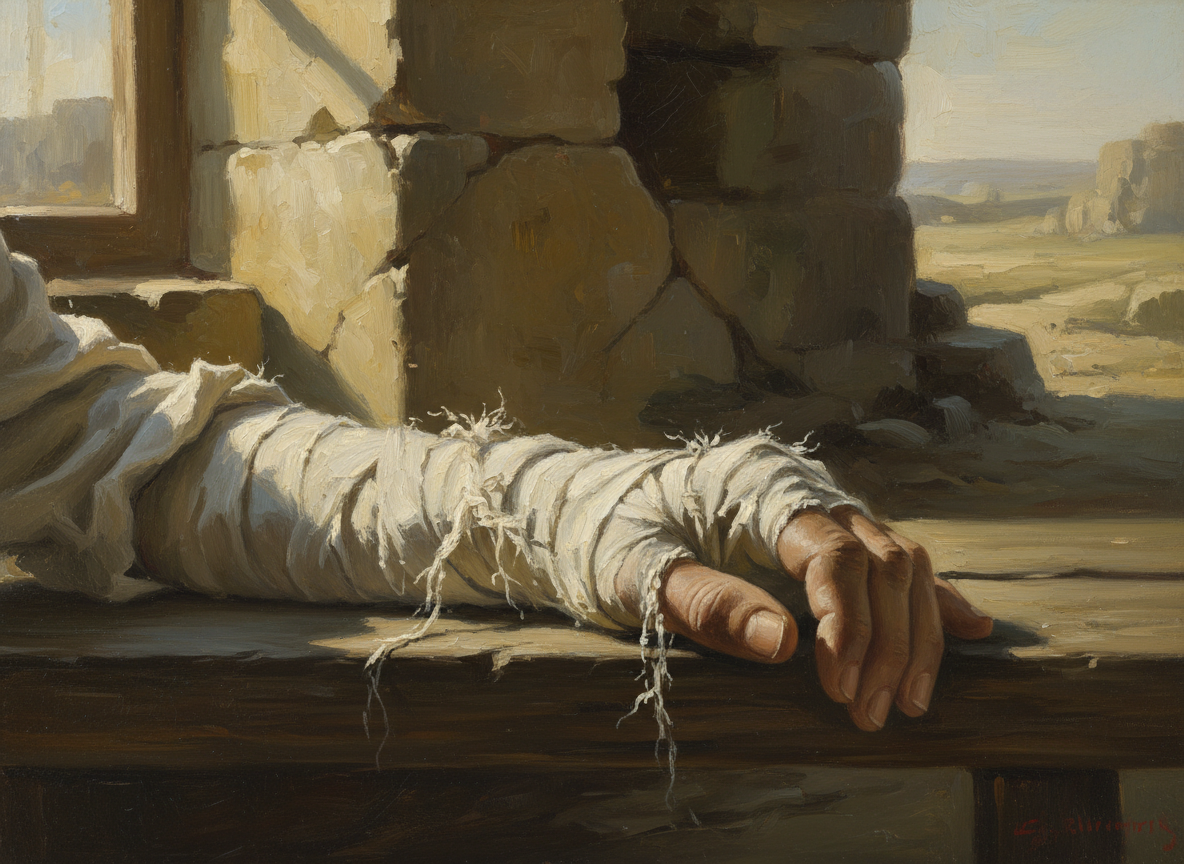
In Sanhedrin 98b the sages ask where Moshiach is found. He sits among the lepers at the gates of Rome. The others remove all their bandages at once to change them; Moshiach unwraps and rewraps one bandage at a time, so that if the call comes he will not be delayed even a moment.
In the same passage the Gemara refers to Moshiach as “the metzora of the house of Rebbi” — not as a passing phrase but as his name in that moment. The anointed redeemer of the Jewish people and the entire world is called a leper, described as sick, isolated, sitting outside the city among the afflicted. The Gemara leaves us with that image.
Check-in: In your own words, why does the Gemara say Moshiach rewraps his bandages one at a time — and what does that detail reveal about his state of readiness?
2. The Rebbe’s Question
In Sefer HaSichos Tazria-Metzora 5751 (pp. 496–497), the Rebbe stops at the discomfort of this name and asks a question that goes to the root of how Torah speaks.
In Jewish thought, a name reveals the inner essence of a thing — the point where what something truly is touches how it is expressed in the world. Moshiach’s very being is geulah: wholeness, revelation, the end of exile. His name should express redemption at its clearest.
Yet the Gemara’s revealed name is metzora — a word evoking exile, impurity, and separation. A metzora lives outside the camp, cut off from the community, associated with broken relationships and spiritual isolation. How can such a word be the name that uncovers the inner truth of Moshiach himself? This is the Rebbe’s question.
Check-in: What is the Rebbe’s core question about the Gemara’s name for Moshiach — and why does the word metzora seem so unexpected as a name for the redeemer?
3. What a Metzora Actually Is
To feel the depth of the Rebbe’s answer we need to understand what tzaraas really is. In Likkutei Torah on Parshas Tazria (22b), the Alter Rebbe raises a sharp question: the Torah introduces the laws of tzaraas with the word adam — the highest of the four names for a human being, associated with inner wholeness and refinement. If the Torah is introducing a state of impurity, why use the loftiest word?
The Alter Rebbe explains that this is deliberate. The subject is someone on a very high spiritual level who has already purified his inner thoughts, emotions, and character through Torah and avodah. For such a person, what remains is only a subtle residue clinging to the outermost layer — like dust on the surface of the skin. Tzaraas is how Hashem draws that final residue outward where it can be seen and removed. It appears on the skin precisely because the inner person is already complete.
A metzora is therefore not someone deeply impure. A metzora is someone almost entirely pure, standing in the final stage of purification. That distinction transforms how we read the word wherever it appears — including in our Gemara about Moshiach.
Check-in: According to the Alter Rebbe’s teaching, what does the Torah’s use of the word adam signal about the spiritual state of someone who develops tzaraas — and how does this reframe what a metzora actually is?
4. Exile Is Hidden Redemption
With this frame, the Rebbe invites us to look at history. For thousands of years, Jewish souls have descended and ascended, and generations of tzaddikim have refined the world through Torah and mitzvos. This work has accumulated. The world has been purified layer by layer until its inner core is already aligned with Hashem’s will.
What we still experience as exile is not evidence that this work has failed. It is the outermost layer of concealment that remains. There is a covering over the surface of reality that does not yet reveal what is already true within. In this light, exile is not a separate reality needing to be built into redemption from scratch. Exile is the redemption itself, covered and hidden. The light is fully present — just not yet visible.
This does not shrink the pain of exile or turn suffering into metaphor. It reframes what this moment in history is: we are not wandering far from home. We are standing at the threshold, in the final narrow place between what is and what is revealed.
Check-in: How does this section reframe what exile actually is — and what does it mean to say that exile is “the redemption itself, covered and hidden”?
5. The Double Suffering of Moshiach
Chazal place Moshiach among the lepers at the gates of Rome — not above exile looking down, but inside it. Every experience of Jewish suffering is real to him. He waits alongside every Jew wherever he or she is. That is the first layer of his pain.
But there is a second, harder layer. Moshiach does not only feel exile as we do — he also knows. He knows that the world’s inner core is already purified, that geulah already exists in its essence, that only the outermost covering remains. He carries that knowledge constantly.
For someone with that awareness, exile is deeply paradoxical. The gap between what truly is and what appears to be is felt with full clarity — not softening the pain, but sharpening it. Every moment the world still looks like exile is a moment of waiting for a curtain to rise on a stage that is already set. His suffering has two layers: the actual pain of exile, and the inner anguish of knowing it is almost over yet not yet gone.
Check-in: Identify the two distinct layers of Moshiach’s suffering described in this section — how does each one arise from his unique position?
6. Why “Metzora” Is the Answer
We can now return to the Rebbe’s question. In light of the Alter Rebbe’s teaching, metzora looks different. It names not deep inner corruption but the final phase of cleansing — where the inside is already whole and what remains is pushed to the surface to be removed.
The Rebbe explains that Moshiach is not called metzora despite being the redeemer. He is called metzora because that word names exactly the stage of history he embodies. The world in his time is like the adam of Likkutei Torah: its core is refined, the work of generations is done, and what remains is the last outer covering hiding the truth.
Metzora is therefore a description of nearness, not impurity. When the Gemara calls Moshiach the metzora of the house of Rebbi, it is not diminishing him. It is giving us a map of where we stand in the story.
Check-in: In light of the Rebbe’s answer, explain why the Gemara’s choice of the word metzora for Moshiach is precise rather than puzzling — what does that name tell us about where we stand in history?
7. The Bridge – What This Means for Us
If the world is already purified at its core, our role takes on a different tone. We are not building redemption from nothing — we are becoming vessels for what already exists at the deepest level of reality.
Every act that brings G-dliness into the physical world matters: a blessing made with intention, a moment of learning carved from a busy day, a kind word chosen over a sharp one, a coin given to tzedakah, a Shabbos honored with warmth. Each one thins the last layer of concealment. Our choices align the visible with the hidden, peeling back the covering over a reality that is in essence already redeemed.
We are not creating Moshiach — we are revealing him. With each act of avodah, we narrow the gap he carries: the gap between what is and what appears. In that sense, every honest act today is not only a merit for the future. It is an act of compassion for Moshiach now.
Check-in: According to this section, what is the difference between creating Moshiach and revealing Moshiach — and how do our everyday actions fit into that distinction?
8. Pullquote
“Moshiach sits and waits, suffering the pains of exile alongside us, knowing that the world has already been purified to its core. Only the final outer layer remains. His name tells us where we stand.”
Quick Check: What Did You Understand?
1. In Sanhedrin 98b, where does the Gemara say Moshiach sits, and what does he do with his bandages? A) He sits in the Holy Temple and wraps all his bandages together B) He sits among the lepers at the gates of Rome and unwraps and rewraps one bandage at a time C) He sits in Jerusalem and removes all his bandages at once D) He sits in the House of Study and ignores his bandages entirely Correct answer: B 2. What is the Rebbe’s core question about calling Moshiach a “metzora”? A) Why would a redeemer be called a leper when he embodies wholeness and revelation? B) Why does the Gemara use Hebrew instead of Aramaic? C) Why is Moshiach described as suffering when redemption is joyful? D) Why does the Gemara mention Rome instead of Jerusalem? Correct answer: A 3. According to the Alter Rebbe’s teaching on tzaraas, what does the Torah’s use of the word “adam” (when introducing skin afflictions) reveal about a person with tzaraas? A) The person has fallen to the lowest spiritual level and is deeply impure B) The person is on a high spiritual level whose inner work is complete, and only the outer surface needs final cleansing C) The person is a new convert learning the Torah D) The person has rejected all commandments Correct answer: B 4. How does the teaching reframe what “exile” truly represents? A) Exile is a punishment that must be earned away through suffering B) Exile is the redemption itself, covered and hidden—the light is fully present but not yet visible C) Exile is a sign that the inner world remains corrupted D) Exile is a temporary distraction with no connection to redemption Correct answer: B
Leave a Reply